
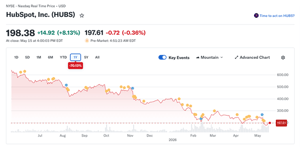
I was driving to the office last Tuesday when my phone buzzed. The CEO of a mid-sized manufacturing company I’ve known for three years had sent me a screenshot: HubSpot’s stock chart. $197 a share. Down 19% in a single day. A red line showing that more than 70% of the company’s market value had disappeared since last year’s peak. No commentary. Just one question. “Igor, still confident in your advice?”
Two months earlier, we had spent an afternoon going over his options. He was deciding whether to bring in HubSpot or let his team build a CRM in-house. They had smart engineers, a few homegrown tools, and the kind of confidence that creeps in after you’ve watched Cursor write in two hours what used to take a developer two weeks. I told him to go with HubSpot. Now he was holding me to it. Fair enough. Any serious leader should push back on an advisor the moment the charts start telling a different story. I wrote back one line: “More than before.”
The next morning, we met for coffee. I asked the waitress for a napkin and drew two lines on it. One sloped down. The other climbed. The first was the share price. The second was the value a customer can pull out of the platform if they use it differently than they did three years ago. The napkin was hardly McKinsey-grade. But sometimes the right decision does not need a deck. It needs a clean distinction.
The stock is not the platform
What happened to HubSpot’s share price is not a collapse of the CRM model. It is a collapse of the old per-seat software model. Those are two very different things. Conflate them, and you will make the wrong call. Separate them, and you start to see something almost no one in Central and Eastern Europe is exploiting properly yet. Start with the numbers. HubSpot is down more than 70% from its 52-week high. Salesforce is dealing with the same pressure, and analysts have a name for it: seat compression. AI agents are absorbing data entry, lead qualification, response drafting, ticket triage, and chunks of frontline support.
Customers are starting to ask why they should keep paying for so many seats when an agent now does part of the work. In April, HubSpot made the kind of move Wall Street rarely rewards. It shifted Breeze agents toward outcome-based pricing: $0.50 per resolved conversation instead of a flat per-seat fee. A few weeks later, the market answered with a 19% one-day drop.
That is what it looks like when a company decides to cannibalize part of its own revenue model before somebody else does it first. Painful for shareholders, but not necessarily bad news for customers. Because customers do not buy the stock. They buy the ability for their sales, marketing, and support teams to do more with less friction. This is not an investment argument. It is an operating argument.
Value is moving above the CRM
Here is the trick most people miss. If HubSpot used to charge €90 per user per month, the logic was straightforward: more seats, more revenue. If the model moves toward €0.50 per resolved conversation, the conversation changes completely. We stop asking how many people have access to the system. We start asking how much work the system actually does. That is an uncomfortable shift for most software vendors because it moves the discussion away from access and toward measurable output. For customers, it can be a much better deal.
If an agent handles half the inbound tickets, the customer is not losing value. Quite the opposite. They are finally paying closer to what they receive: less for presence in the system, more for work completed. Wall Street reports do not capture the operational picture. At two clients of ours running agents in production - one in financial services, one in business services — we are seeing the same number: around 60% of inbound tickets or calls resolved by agents, with no human in the loop.
After the first client, I assumed we had stumbled into a particularly clean use case. After the second, that theory stopped holding. Different industry, different country, same number. That is no longer an interesting demo. That is how support actually starts to run. This is why I see HubSpot’s share price decline as less important than it appears at first glance. Not because the stock does not matter. It does. But it measures something different from what a customer should measure. The stock measures how much profit the platform can extract from the market. A customer should ask a different question: how much work can this platform take off my people’s plates? Those are not the same number.
Building your own CRM is the wrong battle
A year ago, I was telling executives that a homegrown CRM project probably would not get finished. Today I tell them something more uncomfortable: even if you do finish it, you may have burned years of engineering effort on a layer the major platforms are commoditizing as we speak. That is the real problem. Five years of work on something that, in 2026, is no longer where the main difference is made.
Picture two companies of the same size, both making the same decision in February 2026: get CRM, sales process, and customer support ready for the next five years. Company A picks HubSpot, gets it live in four months, and from month six redeploys its best people above it. Not to build generic chatbots, but agents that understand the industry, the products, the internal exceptions, the regulatory wrinkles, and the three types of customers who always create the most work. Twelve months in, they have something a competitor cannot simply order from a catalog. Company B builds its own CRM. Twelve months in, the team is still wrestling with Outlook integration, user permissions, audit logs, and why a form submission does not write cleanly to a deal record. Marketing eventually asks if they can have an agent for lead qualification. Engineering says yes - once the foundation is finished.
That is how a year vanishes. Not in one big strategic error, but in small technical debts that look defensible week by week. The question nobody likes answering is simple: which of those two companies has the better customer experience two years from now?
What we learned the hard way
I owe a confession on my own scorecard. Early in 2025, I told two clients to wait a little longer before putting agents into live customer operations. Not because I doubted the direction. I did not. It just felt early for anything close to mission-critical. Both went ahead anyway. Good thing they did not listen.
Today, they have an edge their competitors cannot quickly close. Not because their prompts are better. That is a shallow read. Their edge is twelve months of operational learning: which cases an agent should own, where a human has to stay in the loop, how to measure response quality, how to prepare the data, and how to walk the team through the change. You do not get that from a workshop.
The second lesson comes from reviewing our own client work. Over the past year at FrodX, we reviewed seven internal CRM and sales systems that companies had built themselves before the AI wave hit. Four ended up in the bin or were replaced by a commercial platform. One lived almost entirely in the head of the original developer - the kind of risk no sensible CFO accepts once someone draws it clearly enough. Two genuinely worked. Both belonged to companies whose primary business is software, with engineering teams north of thirty people.
That was the picture before the AI wave. Vibe coding has not made it less dangerous. It has made it more deceptive. Cursor and Claude write code at speeds that would have sounded like science fiction two years ago. But fast code is not the same as code you can maintain for five years. You feel the difference eighteen months in, when something that looked elegant needs a fix.
Agents are the new differentiator
Here is my bet. HubSpot has better odds than most CRM vendors over the next two years precisely because it started cannibalizing its own pricing before it had to. Salesforce will hurt longer because it has more to defend. Premium licenses are a wonderful business right up to the moment the market starts asking why it is paying both people and agents to do the same job.
But the main story is not HubSpot versus Salesforce. The main story is where competitive advantage will actually form. Every company will have a CRM. The same way every company has electricity, accounting, and email. Nobody wins on the back of a CRM anymore. They win because, on top of it, they have an agent that understands what a good lead, an urgent ticket, a fading opportunity, or a soon-to-churn customer looks like inside their specific business. That is domain knowledge. And domain knowledge is far harder to copy than a platform choice.
A prediction I will put on the record: if by the end of 2027 fewer than half of mid-market B2B companies in our region have at least one vertical agent in production, I called the pace wrong. I will publish that number. No fine print.
Do not waste engineers on foundations
At your next board meeting, run a simple exercise. Ask how many engineering hours per year go into maintaining the CRM foundation, versus the layer above it: agents, data pipelines, decision automation, response quality, faster sales, and better support. If the ratio runs five to one in favor of the foundation, you have a problem. Not because foundations do not matter. They do. But customers never notice foundations. They notice what sits on top of them. HubSpot and Salesforce spend billions on that foundation. You will not catch them on that layer. Not with the best engineering team in the region.
Back to the CEO and the napkin. On Monday, I sent him a photo of the paper, with those two lines still drawn on it. Below, I wrote: “Still holds. More than ever.” He replied that afternoon: “OK, Igor. Let’s go build agents.” The conversation that started with a red stock chart ended in a much more useful place. Over the next ninety days, they will pick three workflows where an agent can genuinely move the needle for the customer. Not three that will look polished in a demo video. Three where people lose time today, customers wait too long, and the data already exists - but nobody puts it to work in time.
Your engineers are expensive. Do not spend them building another CRM. Spend them on agents, processes, and domain knowledge above HubSpot. That is where competitors cannot just buy the same license and close the gap in six months.
Learn why CRM platforms are becoming infrastructure, while real competitive advantage is created in the processes and expertise built on top of them.
