
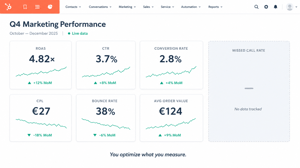
At one of those gallery openings with too many white walls and not nearly enough chairs, I found myself standing next to the marketing director of a company most of you would recognize. Two weeks earlier, he had just closed the kind of quarter most marketers would happily put in a pitch deck and most CFOs would want to double-check. His dashboard had been green for three months straight. You could tell.
Once we got talking, the numbers came out easily. ROAS to two decimal places. CTR by campaign. Conversion rate by device. Even the average number of seconds someone watched a product video before clicking “add to cart”. Meanwhile, his phone buzzed twice on the table. He thumbed both calls away like flies. So I asked him a simple question. “How many people called you yesterday between noon and 1 p.m. and didn’t get through?”
First, silence. Then that polite smile people give you when they’d rather change the topic. “We don’t measure that,” he said. That was the moment it became obvious. We measure everything around the sale - except the moment the buyer is most ready to buy.
We measure everything except buying intent
This is not a story about one marketing director. It is a pattern. Companies will argue about a 0.3% difference in CTR while having no idea how many calls went unanswered yesterday. Let me put it this way: if you don’t know how many calls you missed last week, your ROAS is not a metric. It’s reassurance.
The first call is not just another touchpoint. It is often the moment of highest intent. Someone saw something, read something, compared something. Something caught their attention or created enough urgency. Then they picked up the phone because, in that moment, they were ready to take the next step. When nobody answers, you don’t just lose the call. You lose the money you already spent to make that call happen.
In B2B, the damage is usually higher. A call is rarely an impulse. It’s usually the final step after someone has read your case study, checked your references, hunted for pricing - if you publish it at all - and decided they’re done typing. That person isn’t looking for another white paper. They’re looking for an answer.
A missed call is not a lead
The usual excuse is: “That’s a support problem.” Or: “That’s a staffing problem.” It’s not. It’s a problem of architecture and ownership. Marketing works around the clock. Ads keep running. SEO keeps working. Referrals keep coming in. Retargeting doesn’t take a lunch break. The phone, however, works only when someone is available. The two systems are out of sync -and then we wonder why the funnel leaks.
In our work, a surprising share of missed business calls happen outside office hours. In the evening after meetings. Early in the morning. On weekends. Exactly when the caller often has more time and less patience. Marketing is still buying attention. Sales has gone home.
And when you tell yourself you’ll call them back later, the math gets uncomfortable fast. Research on lead response time has been pointing in the same direction for years: the first few minutes matter disproportionately. The InsideSales.com/MIT study analyzed more than 15,000 leads and over 100,000 call attempts. The difference between responding in five minutes and responding in thirty? Up to 100 times lower odds of making contact and 21 times lower odds of qualifying the lead.
Harvard Business Review later gave the problem a fitting title: “The Short Life of Online Sales Leads”. Workato tested 114 B2B companies and found that only one sent a personalized email within five minutes. Not a single one made a phone call in that time. I’ve shown these numbers to a lot of sales directors over the years. They all nod. Almost none of them change anything by Monday. And then we wonder why marketing needs more money to produce the same result.
What does silence cost?
Let’s take a real example. One of our clients runs a mid-sized e-commerce business. Two support agents. Both handling more than 50 tickets a day. Efficient on paper. Close to breaking point in practice. I’ve seen too many teams like this to call it an exception.
The result: 360 missed calls per month. Not just at 10:30 p.m. A large share came before 9 a.m., during lunch breaks and at peak times when both agents were already on calls. Every one of those calls belonged to someone with intent - and money to spend. And every one had already been paid for through ads, SEO, referrals or whatever channel brought them in. If the average inquiry value is €70, 85% of those people don’t come back, and conversion is 30%, the math is painfully simple: 360 × €70 × 12 × 0.85 × 0.3 = €77,112 per year.
That doesn’t include repeat purchases. It doesn’t include referrals. And it doesn’t include the fact that someone you ignore today may not even consider your brand six months from now.
Here’s the strange part: most marketing directors can tell you their CPL from memory. They can’t tell you their missed call rate. That’s absurd, because missed call rate is often a bigger leak than bounce rate. You just don’t see it in Analytics. When someone calls and nobody answers, they don’t think, “This company has a capacity issue.” They think you’re not serious. In B2C, that can mean a lost purchase. In B2B, it often means lost trust - and trust is much harder to win back.
Even worse: when you don’t pick up the phone, you’re not just losing business. You’re helping your competitor. The caller opens Google, clicks the next result and someone else answers. You paid for the attention. Someone else gets the order.
You don’t need another shift. You need a system.
“Let’s just hire one more person” sounds reassuring. It’s often the most expensive reflex. If a large share of your calls happens outside business hours, will you hire someone for evenings? Weekends? Holidays? And how much will that cost before you even know which calls are worth handling?
That’s why, at FrodX, we don’t sell this as “the future of AI”. I’m interested in a much more boring question: how much money disappears because nobody answers? That’s also why we built Kinetara - an AI voice agent that answers, classifies and documents calls without a new shift behind it.
When people hear “AI agent”, they often imagine a robot that sounds like a broken ticket machine at a train station. In practice, it’s more mundane - and more useful. With one of our clients, we currently measure 80% of calls answered in under three seconds, 68% recovery of previously missed calls and 95% caller satisfaction. No new shift. No night staff. No holiday overtime. But the biggest benefit is not that AI replaces a person. The biggest benefit is that you finally get a record where today there usually is none. Who called. When. Why. How long the phone rang. Where people dropped off. How many got lost in the IVR. What happened after the first, third and fifth ring.
You can connect that data to campaigns, locations, products and business hours. The phone stops being a black hole between marketing, sales and support. It becomes a channel you can measure, improve and tie back to revenue.
A question for this week
Run a simple test. Ask your marketing director about CTR, open rate and ROAS. Half the KPIs will come straight from memory. Then ask how many calls you missed, what share came outside business hours and how many people dropped off in the IVR. If you get a clear answer, you have a rare team. If you don’t, you’ve got your homework for the week.
In 60 minutes, set a baseline. Not a rough guess. A number. How many missed calls? When? From which sources? What happens after the first, third and fifth ring? If you want a second pair of eyes on where your phone is leaking revenue today, book a 15-minute conversation. I’ll tell you in plain numbers what I’d look at first.
Your phone is your most expensive landing page. It’s just the one nobody bothers to optimize.
