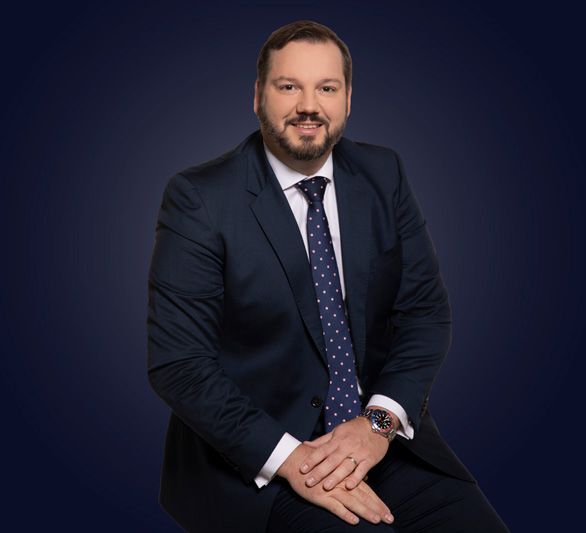
Goran, we're going to talk about investing. About how to make people realize that strategic investing matters. Is this even possible in our environment? What can actually be done?
Well, quite a lot. Let's start at the beginning, or maybe a bit later. Up until the 2007 financial crisis, Slovenian investors basically didn't know what a loss was. Markets were growing, especially the famous Balkan market, and products practically sold themselves. Then came the crash. Losses were massive, over 50% in some cases, and Slovenian investors pulled back into what they know best: cash and deposits.
That's when it became crucial for the entire industry to find a way to bring capital markets back to people. And for that, you need marketing. Our language is very technical. If I start explaining the Sharpe ratio to you, your eyes will glaze over. But if I tell you that you can be a part-owner of Apple, whose phone you're holding in your hand, and that you'll benefit from the company's growth too – that's a completely different story. We needed someone who could translate our technical language into stories people actually understand.
How did this translation work in practice? You started analog, with letters and invitations, and now you're heavily digitalized. Marketing and sales had to connect. How did this transformation happen, and what role did FrodX play?
How did this translation work in practice? You started analog, with letters and invitations, and now you're heavily digitalized. Marketing and sales had to connect. How did this transformation happen, and what role did FrodX play?
"If I start presenting an investment with the Sharpe ratio, your eyes will glaze over. But if I tell you that you can be a partowner of Apple, that's a completely different story.
What are the concrete results of webinars, digitalization, and the collaboration between marketing and sales? Which customer segment responds best?
The results are definitely positive. Processes are faster, we're reaching customers we couldn't before. At first, we thought our ideal clients would be young people, 18 or 20 years old. But it turned out to be mainly people between 27 and 45. That's when they get jobs, start families, and begin thinking long-term. At 17, you might play around with crypto; at 27, you usually start building something more stable.
Webinars show the biggest impact. On average, we get 500 to 600 registrations for each one, and more than half actually watch it live. Still, digital channels haven't taken over completely. The old-fashioned way is still very important. With larger amounts, clients want to walk through the door, see the advisor and the building where their money is being managed. With smaller amounts, like saving 30 or 50 euros a month, we see the entire process moving into the digital world.
Competition in finance is huge. On one side, you have traditional banks and other asset management companies; on the other, new players like neobrokers and ETF providers. How do you position yourselves in this environment?
We need to look at the bigger picture. We're a very young and simultaneously conservative market. Slovenians basically have two baskets for their wealth. One huge one, with just cash and real estate. Then there's a tiny basket representing 5-10% of wealth, and we throw everything else in there – from pyramid schemes to bitcoin to our funds.
Our main competition is other asset management companies, and also inactivity – those 30 billion sitting in accounts. Neobrokers and crypto don't worry us as much because they target a different investor profile. We're not interested in a fifteen-year-old buying bitcoin because he heard about it on TikTok. We'll care about that person in ten years, when he starts thinking long-term. ETFs are a welcome addition, but you have to be careful. Does an ETF actually contain the investments it claims to? How is my wealth protected? Who can I turn to? Our funds are actively managed, meaning we constantly adjust investments based on market conditions.
Financial literacy in Slovenia is still a big challenge. How do you see this, and what needs to change?
Education starts at home, but the state could play a bigger role too. Things are improving – individual investment accounts have been announced, which is a great step. But there's no systematic framework. Why not have one hour of financial literacy per week from fifth to ninth grade? Part of the problem is also our mentality. Anyone who succeeds gets immediately labeled a tycoon. But even this is changing with new generations. Young parents are increasingly opening savings accounts for their children and teaching them how to handle money.
Working with investors, you've probably heard quite a bit. Got any interesting stories?
Financial advisors are sometimes like therapists. One story really stuck with me. During the 2006 investment boom, a gentleman came to me, a carpenter, and said: “Everyone around me is making money with everything except work. I'd like to try too.” He brought a substantial amount and said: “Do whatever you want. I'll come back for the money in six months.” We invested in a Balkan stock and in half a year, he made sixteen times his money. When he came back, he almost fell off his chair. We were rubbing our hands together, already planning the next investments, but he said: “Cash me out.” He'd been prepared to lose that money; he just wanted to see what it was all about. And he never invested again. This shows that we still need to develop the mindset about investing, to make it as natural as wanting to own your own apartment.
How do you personally view investing, and how do you deal with the stress that comes with the financial world? Any advice?
The best advice is probably this: watch out for advisors who claim to know everything. Otherwise, my wife would say the cobbler's children go barefoot. I'm very pragmatic. Most of my wealth is in our funds because I believe in what we do. When I was younger, I'd occasionally venture into some wild investment, but not anymore. I stick to the classics. As for stress, I handle it better with age. My outlet is mowing and maintaining our lawn at home. For a couple hours a month, my thoughts escape from work and obligations. Everyone needs to find something like that, especially in more tense times.